
No Chesterfield 72-Hour Release Feed
No verified Chesterfield County website displays everyone released during a rolling 72-hour period. The Sheriff's official booking-record instructions expressly say booking records are not immediately online. Instead, they route visitors to a short recent-arrest phone check, in-person booking reports for a specified period, and the South Carolina Public Index for older cases.
The lack of a feed means there is no online update schedule, fixed list of fields, photograph flag, or published three-day retention window to describe. It also means a weekend list cannot be reconstructed from social posts or a commercial jail site. The defensible method is to define the three days and request the existing records that fall inside them.
Check Chesterfield County Three-Day Releases
A three-day inquiry works best when it names the facility and treats booking and release as separate events. The Chesterfield County Detention Center and Chesterfield County Work Camp share the Goodale Road address but are separately named operations with different telephone numbers. Name the known placement so staff do not have to infer which local record system is meant.
- Write the exact start and end timestamps for the 72-hour interval, including the time zone if ambiguity is possible.
- Identify the Detention Center or Work Camp and provide a name or other identifier when seeking one person.
- Visit 319 Goodale Road during business hours and ask for booking reports covering the stated period.
- Ask for the existing release log or release entries for that same range, including transfer information if maintained.
- Use the jail record for the physical custody event, then compare court actions and any receiving-agency record.
- Submit a focused written FOIA request if the release entry is not available through the informal route.
If only the current day matters, the Chesterfield County 24-hour release guide narrows the period and adds the local Bond Court timing context. A shorter range can be easier to review, but it may miss an overnight or weekend event.
Chesterfield 72-Hour Record Fields
Chesterfield County has not published a standard online report, so the table describes fields that may be requested from existing jail records. It does not promise that every item exists in every entry. Asking for the precise pieces needed to verify the event is more useful than demanding a custom “72-hour list.”
| Requested field | How it helps across three days |
|---|---|
| Full name and identifier | Separates similar names and connects the correct booking across the full interval. |
| Booking number | Links the release to the specific jail admission rather than an older case. |
| Admission and release date/time | Shows whether the stay and exit fall inside, overlap, or sit outside the chosen window. |
| Release disposition or authority | States how this facility's custody ended, using the agency's own terms. |
| Charge, bond, or court reference | Provides the key needed to compare the custody entry with the court docket. |
| Hold, transfer, or destination | Distinguishes community release from movement to another custodian when recorded. |
A release reason should not be guessed from a charge result. Bond does not mean acquittal. A dismissal is a court outcome, while the jail entry records the authority under which physical custody ended. A transfer means confinement continued somewhere else.
Other terms also have distinct scope. Time served or sentence expiration refers to completion or credit against confinement. Parole concerns release from state imprisonment while the sentence continues under supervision. Probation can follow a sentence or be ordered without an SCDC stay. An ICE hold may end county custody through a handoff. The agency's own wording should be preserved, especially when a short disposition code is not self-explanatory.
Chesterfield Weekend Release Windows
A 72-hour range is most useful when it bridges days that are easy to overlook. It can include a Friday evening through Monday evening, or another exact span chosen around the event. Chesterfield County publishes Bond Court settings, but it does not publish release-processing hours or a rule that an exit will occur on the same day as a hearing.
The Chesterfield County Magistrate page places Bond Court at the Detention Center and lists weekday settings at 8:30 a.m. and 3:00 p.m. It lists weekend settings from 8:00 to 10:00 a.m. and at 5:00 p.m.; holiday hours vary. These are hearing times, not release times. Bond must be satisfied, paperwork processed, and other holds checked before a physical exit can occur.
A three-day query can catch the later jail entry when a court event and custody event land on different dates. It can also show that a transfer, rather than a release to the community, occurred after the hearing.
Chesterfield's Bounded Records Method
The Sheriff's local information design makes the difference between arrest, booking, and release visible. Its telephone route covers a possible arrest within only the past 12 hours. Its in-person route lets a visitor ask for booking reports over a stated period. Its older-case instructions point to court records. For a 72-hour release question, the in-person period is the relevant starting point, followed by a request for the related existing release entry.
The screenshot below is from the official Chesterfield Sheriff Booking Records Requests page.
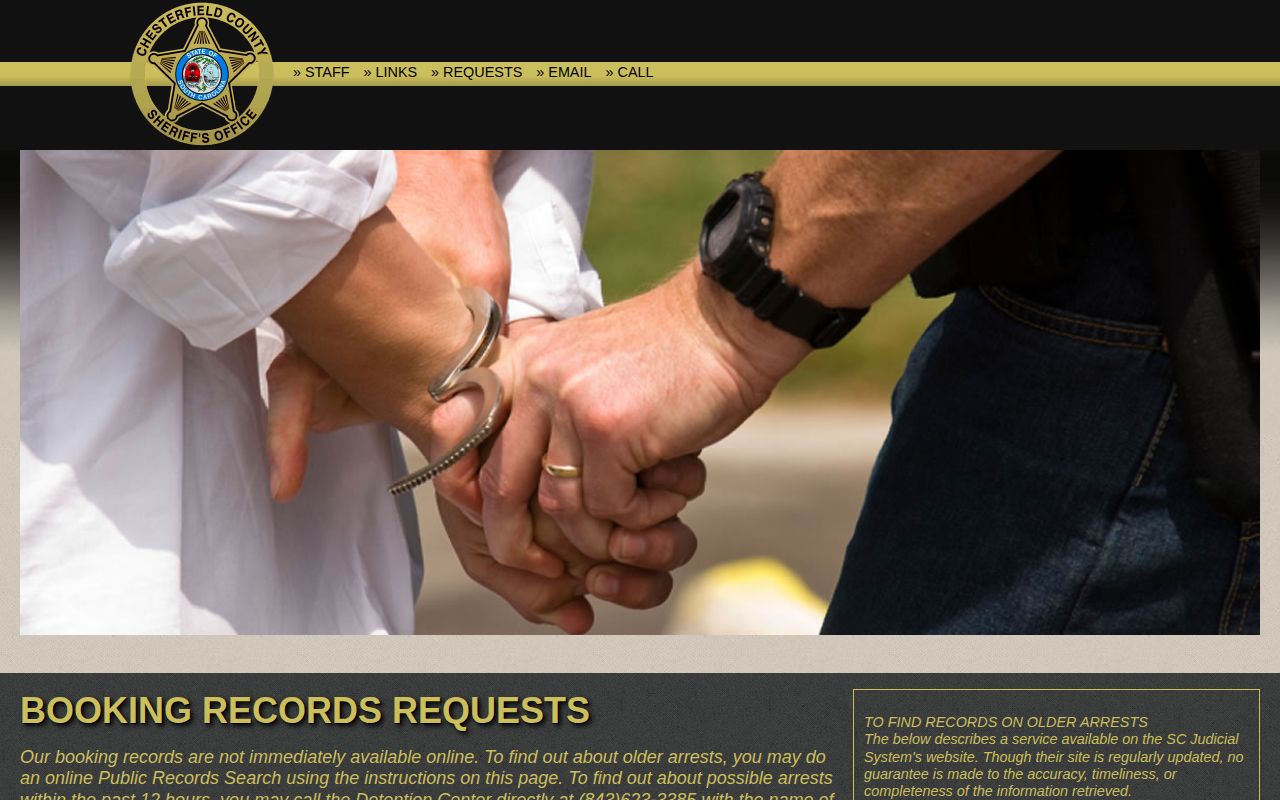
The source confirms why a date-bounded request is the honest substitute for a rolling list. It does not establish a 72-hour web archive, and it should not be read as promising release fields that are not displayed.
The source also helps screen out wrong-jurisdiction results. Chesterfield County, Virginia, has a much larger online footprint, but its jail agencies and programs do not describe Chesterfield County, South Carolina. Local records should connect to the South Carolina Sheriff's Office, the county domain, Goodale Road, or the South Carolina Judicial Branch before they are used to interpret a release.
Chesterfield Release Access After Three Days
The phrase “72-hour list” describes the requested time span, not how long Chesterfield County keeps a record. With no public release site, no online retention period can be inferred. South Carolina FOIA Section 30-4-30(D)(3) provides that documents identifying people confined in a jail, detention center, or prison during the preceding three months are available for in-person inspection during business hours, unless an exemption applies.
That three-month provision is an immediate inspection category. It is not a destruction schedule and does not mean an entry vanishes on the next day. Court cases may remain much longer in the Chesterfield Public Index. Sealing, expungement, juvenile restrictions, or another lawful limit may later restrict identifying material.
For a written request, provide the 72-hour bounds, the relevant Chesterfield facility, and the fields sought. Ask for the existing log or entries rather than a newly compiled report. A narrowly framed request also makes it easier for the custodian to identify the responsive record and explain any withheld part.
Name the Work Camp when that was the known placement. The statewide jail administrators directory lists it separately from the Detention Center even though both use 319 Goodale Road and share fax 843-623-2088. The Work Camp telephone number is 843-623-7234; the Detention Center number is 843-623-2261. This supports routing a request to the right named operation, not a claim that each has its own online database or separate release desk.
If one request covers both operations, say so expressly and keep the date limits the same. If only a person's placement is uncertain, include the identifying details and ask which office maintains the responsive jail entry. The goal remains the actual record of departure, not a new summary produced for the requester.
County, State, and Federal Release Records
The Chesterfield jail record is the primary source for someone arrested and released locally. For a completed state-prison release, the separate SCDC Released Inmate Search accepts a release-date range and county filter. Its county filter does not turn state-prison results into Chesterfield jail releases. The ordinary SCDC portal shows current state prisoners as of the prior midnight and excludes people already released.
VINELink can provide an informational change notice for a participating record, but Chesterfield County jail participation was not independently confirmed through an official county coverage list. Ask the jail before relying on it. For a federal case, the BOP locator is the relevant public custody system. An immigration transfer calls for ICE verification. Each system answers for its own custodian.
A person may leave Chesterfield County custody and still remain confined through SCDC, another county, federal authorities, or ICE. A completed jail release entry, court docket, and receiving-agency result together resolve that difference. For a one-person search across those systems, use the Chesterfield County release-record guide.
Update timing differs across these sources. The ordinary SCDC search reflects the previous midnight, while community-supervision results are from the previous day and VINELink depends on data from a participating agency. A release alert can lag, and a court disposition can predate the jail's physical exit. Across a 72-hour span, record each source's timestamp and coverage before comparing results.
Finally, a negative current-custody result is inconclusive by itself. It may reflect release, transfer, a spelling mismatch, a system outside the search, or an update delay. The county release record supplies the event that the broader lookup cannot. When the jail entry names a receiving custodian, continue with that custodian's system instead of labeling the person released to the community.